
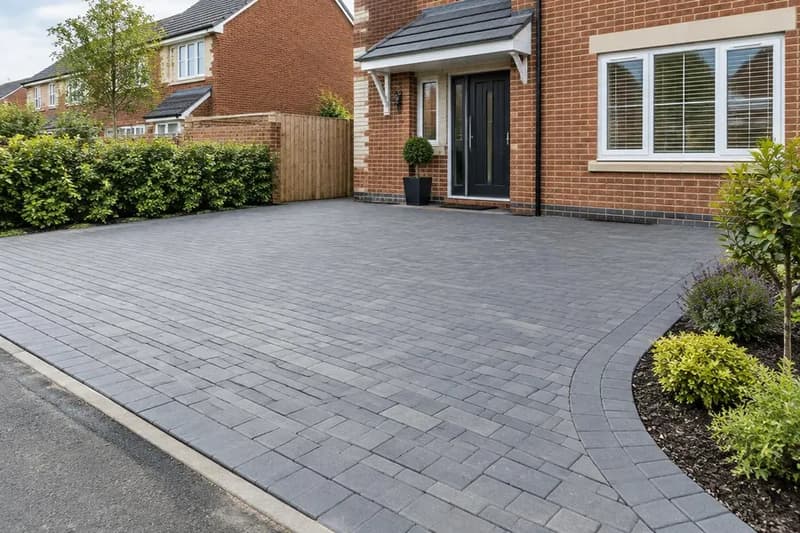
Why the groundwork matters most
Cars are heavy, and a driveway has to carry them every day for years. The surface you see is only the top layer. Underneath, the ground is excavated to a suitable depth, any soft or organic material is removed, and a sub-base of crushed stone is laid and compacted in layers. Skipping depth or compaction here is the main reason driveways dip, crack or develop ruts.
Edging and restraint
Every driveway needs firm edges to stop the surface spreading outwards. Kerbs or edging set in concrete hold everything in place and give clean lines against lawns and borders. Where the drive meets a boundary, a low brick wall or pillars can do the same job and add to the look of the property.
Drainage and the planning rules
Since 2008, new or replacement front garden hard surfaces over five square metres need to let water drain through them or direct it to a lawn, border or soakaway, otherwise planning permission is needed. Getting this right protects you, your neighbours and the drains in your road. Our driveway planning permission guide explains the rules in plain English, including dropped kerbs, which are handled separately by the highway authority.
- Water must not run onto the road or pavement
- Permeable build-ups or soakaways keep you within the rules
- A dropped kerb needs separate approval from the council
- Levels should fall away from the house and garage
Planning the layout
A good layout considers how many cars you need to park, how you get out of the doors, where bins live and how people walk to the front door without stepping on the lawn. Turning space, the gradient from the road and existing manholes all shape the design. George will walk the frontage with you and explain the options.
Choosing a surface
There are several driveway surfaces on the market, each with different looks, maintenance and drainage behaviour. We will talk through what suits your property at the visit. Our driveway cost guide explains how area, dig-out, base, edging and drainage drive the price, whichever finish you choose.
One team for the whole frontage
Because brickwork is at the core of the business, we can build the boundary walls, pillars, planters and steps alongside the drive, so the front of the house is finished together. All work is insured and backed by our 10-year guarantee.
Keeping disruption to a minimum
Replacing a driveway means losing access to it for a while, so we explain in advance how long cars will need to be parked elsewhere and when skips or deliveries will arrive. Neighbours are kept in mind too, with the pavement kept clear and the road left tidy at the end of each day. Once the surface has been laid and finished, we will tell you when it is ready to drive on and how to look after it through its first winter.
Driveway drainage and SuDS
Sustainable drainage, often shortened to SuDS, simply means dealing with rain where it falls instead of sending it into the road drains. On a driveway that can be a permeable surface with an open-graded stone base that lets water soak through, or a sealed surface that falls towards a lawn, border or soakaway. Which one suits your home depends on the soil, the slope of the frontage and how much space is free for water to go.
Clay ground drains slowly, so a soakaway there needs to be sized and placed carefully. Where water already pools on an old drive, a channel at the low point or a revised fall usually solves it. Our garden drainage page explains the same principles for back gardens.
Help with costs, rules and local work
Our driveway cost guide explains the price factors, and the driveway planning permission guide covers the front garden rules. As local driveway contractors we work across Northampton and nearby towns, including driveways in Kettering.
Gradients, garages and thresholds
Some frontages slope up or down from the road, which affects how comfortable the drive is to use and where water ends up. A drive that falls towards a garage door or the front of the house needs a drainage channel at the low point, and levels at the door threshold must stay below the damp-proof course. We check these details on site so the finished driveway is easy to use in all weathers and water is always carried away from the building.
Tarmac and gravel driveways
For a smooth, dark finish see tarmac driveways, which also explains imprinted concrete. For a free-draining loose surface, see gravel driveways.