
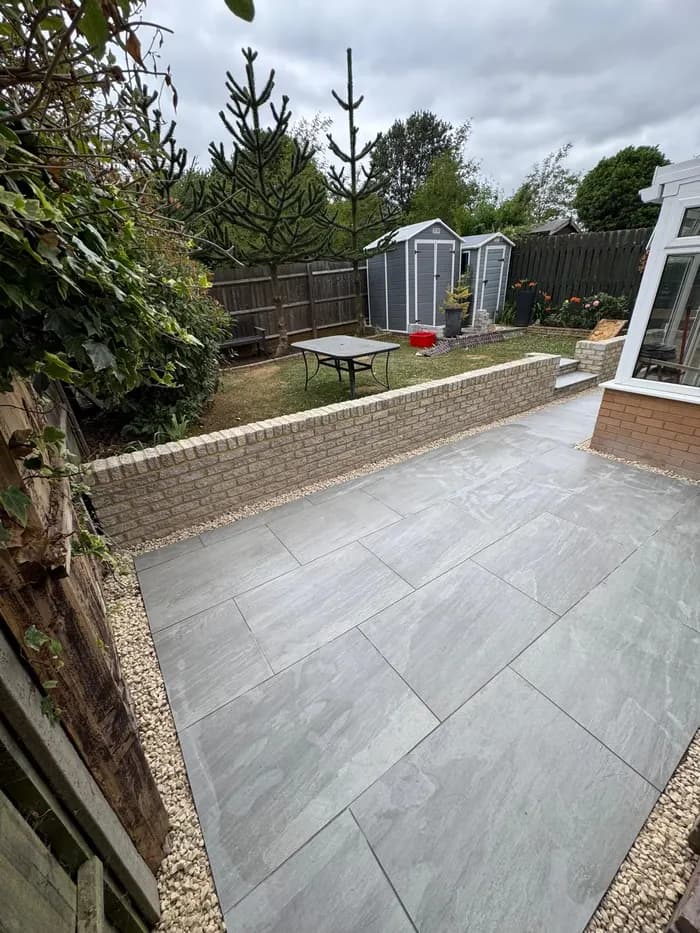
Signs your garden has a drainage problem
Some clues are obvious, others creep up over a few winters. If you recognise more than one of these, it is worth looking at how water moves across your plot before you spend money on new paving or turf.
- Puddles that stand on the patio long after a shower
- A lawn that squelches underfoot for weeks at a time
- Rain running across the paving towards the back door
- Slabs with dark stains, green algae or a rocking corner
- Soil washing off a bank onto the lawn below
Why Northamptonshire gardens hold water
A great many gardens in the county sit on heavy, clay-rich soil. Clay is fine for many plants, but it lets water through slowly, so after a wet spell the top layer stays saturated. Once it is trodden on or driven over, it packs down even tighter.
Gardens on new houses often suffer most. During construction the ground is crossed by machinery and covered with spoil, then a thin layer of topsoil and turf goes on top. The compacted layer underneath acts almost like a sheet of plastic, and the lawn above never quite dries out.
Hard surfaces can make things worse. A patio laid dead flat, or tilted back towards the house, leaves water with nowhere to run. On a sloping plot, every shower sends water from the higher ground down onto whatever sits at the bottom, whether that is a lawn, a path or the rear wall of the house.
How we handle drainage in hard landscaping
Most garden drainage problems are solved by shaping surfaces properly and giving water a planned exit. When we lay a patio or path, it goes down with a steady fall away from the building, and we decide in advance where that water will finish up.
Where paving meets a door, a channel drain across the threshold catches water before it reaches the house. Permeable bases let rain soak down through the build-up rather than across the top. On ground that can take it, a soakaway gives collected water a place to disperse slowly underground. Sometimes the fix is simply to lift and re-level slabs that have sunk or were laid the wrong way.
- Correct falls on patios, paths and driveways
- Channel drains at doors and thresholds
- Permeable sub-bases and jointing
- Soakaways where the ground is suitable
- Lifting and re-levelling sunken paving
Sloping gardens and retaining walls
A slope can be turned into a real feature, but only if the water running down it is dealt with. When we terrace a garden with retaining walls, the wall needs free-draining material behind it and a way for water to escape at the base, otherwise pressure builds up behind the brickwork. The bottom of the slope also needs a planned route for runoff. Our sloping garden landscaping page explains how levels, walls and steps fit together.
Why drainage comes first in a garden renovation
It is tempting to start with the nice bits: the paving, the planting, the lighting. But drainage has to be sorted at the groundwork stage, before anything is laid on top. Fitting a channel or a soakaway into a finished garden means lifting what has just been put down. That is why every garden renovation we plan begins with how water will leave the site, and why our garden renovation cost guide treats groundwork as a key part of the budget.
What to show George at a visit
The more you can tell us about how the garden behaves in wet weather, the easier it is to work out the cause. Photos taken during or just after heavy rain are especially useful, because the problem may not be visible on a dry day.
- Where water collects and how long it stays
- Which way rain flows across patios and paths
- Any downpipes, gullies or drains you know about
- Recent building work or new turf
- Slabs that rock, stain or stay green
Soakaways
Where water needs to go back into the ground, our soakaways page explains percolation tests, the building regulations and the signs of a blocked soakaway.