
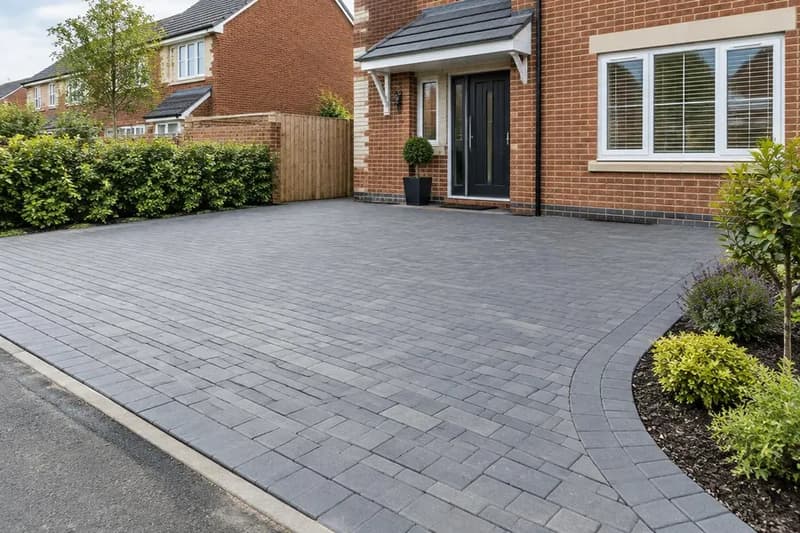
Why front gardens need to drain
When a street of front lawns is paved over with solid surfaces, every shower runs straight into the road gullies. In heavy rain those drains can be overwhelmed, which adds to local flooding and carries oil and grit into rivers. The idea behind sustainable drainage, often shortened to SuDS, is to manage rain close to where it lands.
For houses in England, new or replacement hard surfaces in a front garden larger than five square metres need planning permission unless they are permeable or drain to a lawn, border or soakaway within the property. A permeable drive is the simplest way to stay within that rule without digging separate drainage. Our driveway planning permission guide goes into the detail.
How the build-up works
A normal driveway base is made of stone with fine particles packed into the gaps, which makes it strong but slow to drain. A permeable base uses stone graded so that open voids remain between the pieces. Those voids act like a temporary tank, holding water after a storm and releasing it into the soil underneath.
The surface on top has to let water in too. That might be blocks with wider grit-filled joints, a porous resin bound layer, or gravel held in a stabilising grid. A membrane or geotextile layer often separates the stone from the soil so fine material does not clog it from below.
- Permeable surface layer
- Bedding layer of fine grit, not sand
- Open-graded stone sub-base that stores water
- Separating membrane where needed
- Natural ground that accepts the water
Surfaces that can be permeable
Several finishes can be built as part of a permeable system. Block paving is available in permeable versions with spacer nibs that keep the joints open. Resin bound driveways are porous by nature, as long as the layer below is porous as well. Gravel in a cellular grid is another option for quieter drives. The choice depends on the look you want, how much the drive is used and how much upkeep you are happy with.
When the ground will not drain
Heavy clay, which is common across parts of Northamptonshire, accepts water slowly. A permeable system can still work on clay, but the stone layer may need to be deeper to hold more water, or an overflow may be needed to a soakaway or border. Where the ground is very poor, falls that direct water onto a planted area are another way to keep within the rules. George will look at the soil and the levels before suggesting a build-up.
Keeping it working
The weak point of any permeable drive is the surface pores or joints filling with dirt. Sweeping, clearing leaves before they rot down and topping up joint grit when needed keep water moving. Avoid tipping soil, sand or compost onto the drive during garden work, as it washes into the gaps and slows drainage over time.
Talk it through
A permeable driveway is planned from the ground up, so it helps to discuss it before choosing a surface. See our main driveways page for how we approach the whole frontage, and use the contact page to arrange a visit.
Gravel and soakaways
A gravel driveway is one of the simplest permeable surfaces. Where water needs somewhere to go below ground, our soakaways page explains how they are sized and built.