
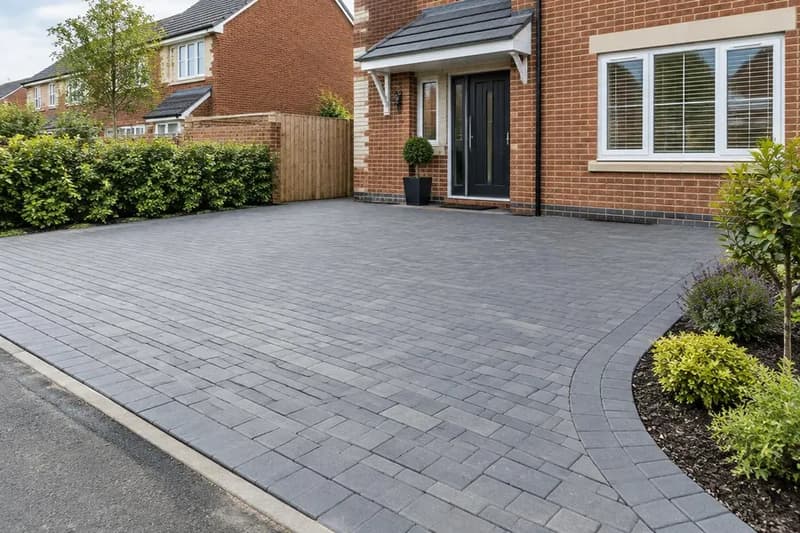
Who owns the pavement
The pavement and kerb in front of your house belong to the highway authority, not to you. In Northamptonshire that is either West Northamptonshire Council or North Northamptonshire Council, depending on where you live. Because it is their land, you cannot simply hire someone to lower the kerb. You apply to the council for a vehicle crossing, and they decide whether one can go in and how it must be built.
As our driveways page already says, a dropped kerb needs separate approval from the council. The crossing itself is often built by the council's own contractor or by a firm working under licence from them, and it is inspected to their standard.
What the council looks at
Every authority has its own policy, but the same questions come up again and again. They want to know that a car can park fully within your boundary without hanging over the footway, that drivers can see pedestrians when pulling out, and that the crossing will not interfere with street trees, lamp posts, drains or junctions.
- Enough depth to park off the pavement
- Visibility for drivers and pedestrians
- Distance from junctions and bus stops
- Street furniture, trees and services in the way
- Whether the road is classified or has extra controls
What we do on your side of the boundary
Superior Build & Landscape builds the driveway that the crossing leads to. That means digging out the frontage, building a compacted sub-base, setting edging and laying the surface so its levels meet the back of the pavement neatly. We plan the layout around what the council is likely to accept, such as parking depth and the width of the opening, and we make sure rainwater stays on your property rather than running across the footway.
If any low walls or pillars need moving to create the opening, that is brickwork we already do. We can also talk you through the information the council usually asks for so your application is clear.
Getting the order right
Timing matters. It is usually sensible to know the council's answer before building the drive, because a refused or narrowed crossing changes the layout. Once approval is in place, the driveway and the crossing can be lined up so the levels match. Our guide to dropped kerb planning permission explains the approval stage, and the dropped kerb cost guide covers what affects the overall price.
Widening an existing crossing
If you already have a dropped kerb but want room for a second car, the extension of the crossing goes through the same council process. On your side, a wider drive may mean removing a section of wall, moving a gate or reworking levels. Sorting both together avoids a drive that is wider than the kerb in front of it.
Next steps
Start by checking your council's current vehicle crossing guidance, then get in touch through the contact page. George can look at the frontage, talk about layout and drainage, and quote for the driveway work around the crossing.