
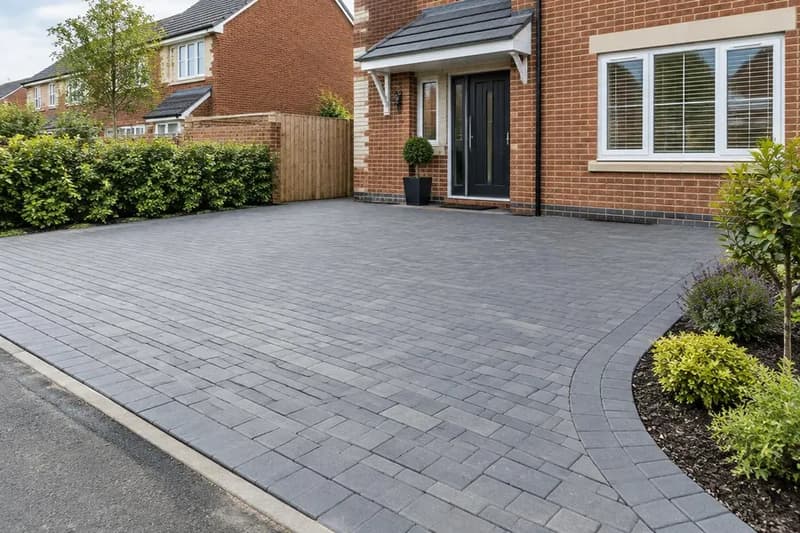
How block paving holds together
Blocks are not glued or mortared down. They stay put because they are squeezed between solid edges and wedged together with fine kiln-dried sand brushed into every joint. When a car rolls over, the load spreads sideways through the pattern rather than pushing one block down. Take away the edge restraint, or let the joints empty, and the blocks start to wander.
That is why the edging is as important as the blocks themselves. Kerbs or a soldier course are set on and backed with concrete along every open side before the main area is laid.
The layers beneath
Under the blocks sits a laying course of sharp sand, screeded to an even depth, and under that a sub-base of crushed stone compacted in stages. The sub-base is what stops ruts forming where tyres run. If it is too thin, or the soil underneath was left soft, the drive will dip in tracks and puddle.
- Dig out to firm ground and remove soft spots
- Lay and compact the stone sub-base in layers
- Set kerbs or edging in concrete
- Screed the sand laying course
- Lay blocks, cut the edges, then vibrate and joint
Patterns and borders
Herringbone is the strongest pattern for a driveway because the interlock resists turning tyres. Basket weave and stretcher bond look good on paths and patios but cope less well with steering. A contrasting border or a band of a different colour can frame the drive, though every extra cut adds time. Clay pavers give a warm, traditional look on older houses, while concrete blocks come in a wide choice of colours and textures.
Permeable block paving
Standard blocks shed water off the surface, so on a front garden they need to drain to a border, lawn or soakaway. Permeable blocks have wider joints filled with fine grit, and sit on an open-graded stone base, so rain soaks straight through. Which one suits you depends on the size of the area and where water can go. Our permeable driveways page sets out the rules, and a dropped kerb needs separate council approval if you are creating a new access.
Block paving on paths and patios
Blocks are not only for drives. They work well for side paths, bin stores and small patios where a hard-wearing surface is needed and the look should match the front of the house. On a patio the base can be lighter than on a drive, but the levels and falls still need to carry water away from the walls.
Ask about your project
If you would like to talk about a block paved drive or path, our block paving cost guide explains what moves the price, our driveway repairs page covers sunken or loose blocks, and you can ask for a quote through the contact page.