
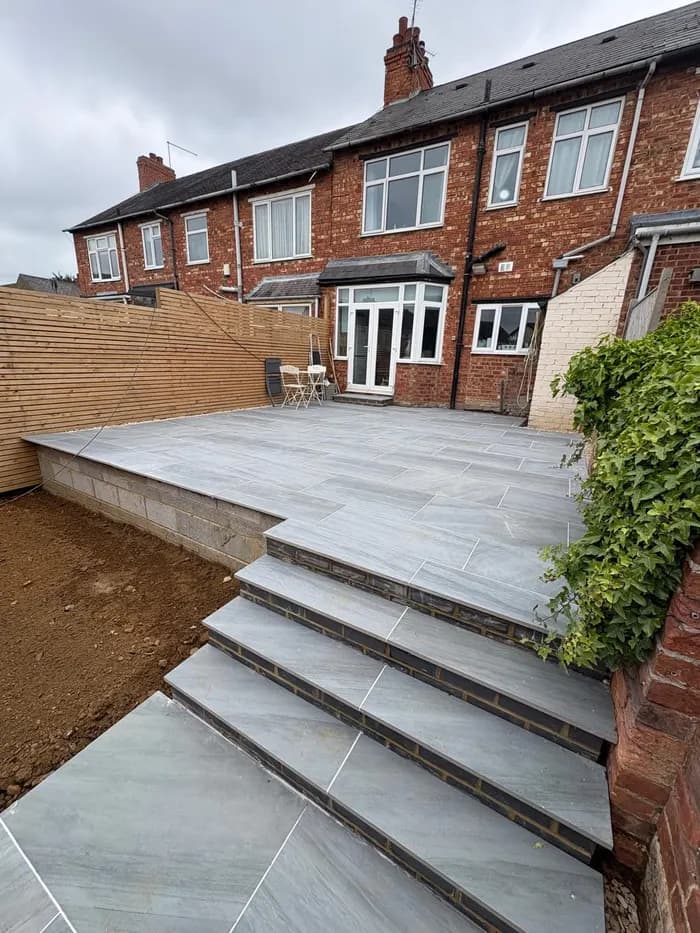
Do I need a retaining wall?
You need one wherever ground has to change level more steeply than soil will sit by itself. Signs include a bank that keeps washing onto the patio, a lawn that slips towards the house, or a plan to cut a flat area into a slope. Very gentle changes can sometimes be handled with a grass bank or a step, but once the soil would slump without help, a wall is needed.
It is also worth checking existing walls. If an old wall has soil higher on one side, it is already a retaining wall, whether or not it was built as one.
Brick, block or sleeper
A brick retaining wall looks the most finished and suits walls that will be seen from the house. Behind the face it is often built thicker, or with a block or concrete core, to take the load. A block retaining wall uses dense concrete blocks, sometimes reinforced and filled, and can be rendered or faced in brick. A sleeper retaining wall uses heavy timber or concrete sleepers fixed to posts and works well for lower changes in level and raised beds.
- Brick: best looking, built to suit the load
- Block: strong core, can be faced or rendered
- Sleeper: quicker, suited to lower walls
Why is my retaining wall leaning?
Almost always because of water. Soil behind a wall gets heavier when wet, and if the water has no way out, the pressure builds until the wall tilts, bulges or cracks. Other causes include a footing that is too shallow or narrow, a wall too thin for its height, tree roots, or extra load such as a driveway or shed near the top.
A small lean that has not changed for years may be stable, but one that is getting worse should be looked at before it fails. Retaining wall repair rarely means patching. Most leaning walls need taking down and rebuilding with proper drainage.
Drainage behind the wall
Every retaining wall we build is planned with drainage. Clean stone behind the wall lets water fall to the base, a perforated pipe or weep holes carry it out, and a membrane keeps soil from clogging the stone. Our garden drainage page explains where that water can sensibly go.
Retaining wall height and regulations in the UK
There is no single height rule for every garden. Taller walls, walls that hold up a driveway or building, and walls near a boundary or highway need more thought and may need a structural engineer's design. Some boundary walls also need planning permission depending on their height and position. As a general rule, the higher the wall and the more it supports, the more it needs proper design, so ask your council or us at the quote stage.
Retaining walls with the rest of the garden
Retaining walls usually come with other work: steps between levels, a raised patio, or a freestanding garden wall continuing the line. Send photos of the slope through the contact page and George will visit to look at the levels before quoting.