
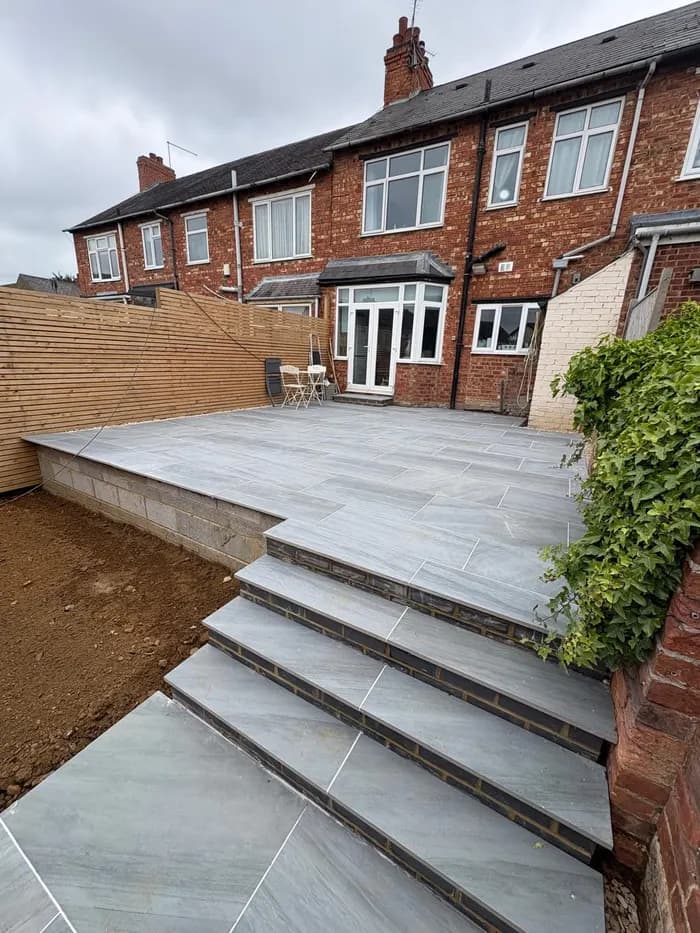
Riven or sawn
Riven sandstone is split along its natural layers, leaving a textured, uneven face and slabs that vary slightly in thickness. It suits cottage gardens and older houses, and its texture gives good grip. Sawn sandstone is cut flat on the top and edges, giving a smoother, more formal finish with tighter joints. Sawn slabs are easier to lay to a precise level, while riven slabs need more care to keep the surface even underfoot.
Laying natural stone
Because riven slabs vary in thickness, each one has to be set individually into a full mortar bed and tapped down to line. Some stones benefit from a priming slurry on the back to improve the bond and reduce staining from the mortar rising through. The base underneath is dug out and compacted in layers in the same way as any of our patios.
Patterns make a big difference. Packs of mixed sizes are often laid in a random pattern, which hides small variations in level. Single-size slabs in straight courses give a more ordered look.
- Ground excavated and sub-base compacted
- Slabs blended from several packs for even colour
- Each slab bedded and levelled individually
- Joints pointed once the bed has set
Natural stone beyond sandstone
Sandstone is not the only natural option. Limestone is denser and usually more uniform in colour, often in blue-black or grey tones, and suits a cleaner look. Granite is very hard wearing. Each stone has its own way of weathering, so it is worth seeing samples wet and dry before deciding.
Slate patios
Slate is a fine-grained natural stone with a dark, often slightly shimmering surface. It looks striking in a modern garden, but riven slate can be slippery when wet and may flake on the surface if the quality is poor. A textured or flamed finish improves grip. Like sandstone, it is laid on a full bed and needs falls that carry rainwater away.
Living with a stone patio
Natural stone is porous, so it can mark from oil, red wine or leaves left to sit. A breathable sealer can reduce staining, though it will change the look slightly and needs reapplying over time. Shady areas grow algae more quickly on stone than on porcelain, so an occasional clean keeps it safe underfoot. Over the years sandstone mellows, which many people see as part of its charm.
Comparing your options
If you prefer a uniform look with very little upkeep, our porcelain patios page covers that route. Where the garden slopes, a raised patio in sandstone with matching steps can look superb. The patio cost guide explains what affects the price, and you can ask for a quote on the contact page.
Sealing sandstone
Sandstone is porous, so many people choose one-off patio sealing after laying or cleaning.