
Close board fencing
Close board is built on site rather than arriving as ready-made panels. Horizontal rails run between the posts and vertical featheredge boards are nailed to them, each one overlapping the last. The result is a solid, strong fence that copes well with wind because the load is spread across the whole run instead of a few panel fixings.
It also follows a slope more easily than panels do, since the boards can step or run with the ground. That makes it a sensible choice for long side boundaries on sloping plots and for anyone who wants a fence that can be repaired board by board.
Panel fencing and slatted screens
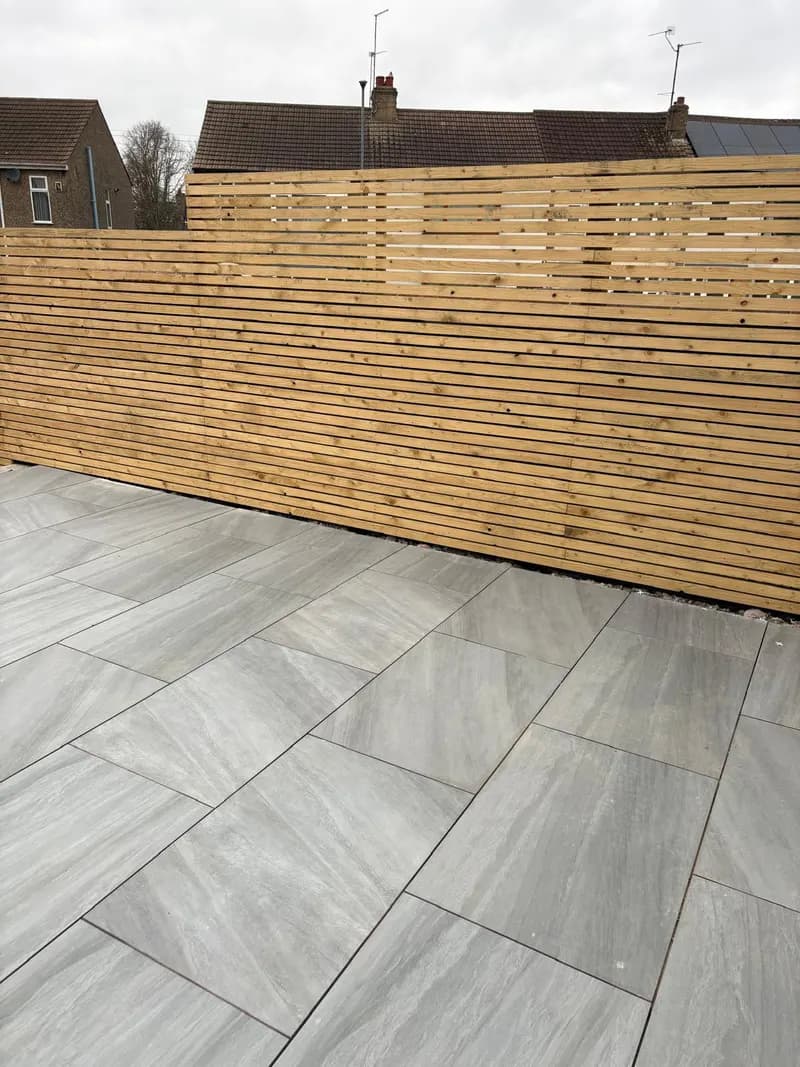
Fence panels slot between posts and go up quickly, which keeps fence installation straightforward on level ground. Quality varies a great deal between panels, so it is worth looking at the thickness of the slats and the frame before choosing. Horizontal slatted screens give a more modern look, and our gallery shows one finished against new grey paving.
Whichever style you pick, a gravel board along the bottom keeps the timber off damp soil. When that board eventually rots, it can be swapped without touching the fence above.
- Close board on rails
- Ready-made panels between posts
- Horizontal slatted screens
- Gravel boards at the base
- Gates to match the run
Posts decide how long a fence lasts
When a fence blows over, the panels are rarely the problem. The posts have rotted at ground level or were never set deep enough. We dig proper holes, set posts plumb and fix them firm so the run stays straight. Timber or concrete posts both have a place, and concrete posts with slotted panels avoid the rot point altogether.
Fencing repair
Not every tired fence needs replacing. Snapped rails, a few broken boards or one leaning post can often be put right on their own. If most of the posts are soft at the base, though, patching one section only moves the failure along the line, and a new run usually makes more sense. We will tell you honestly which situation you are in after looking at it.
Fences with walls, patios and the rest of the garden
A fence often sits on top of or beside other work. A low brick plinth with fencing above gives a solid base and a lighter upper section, and our garden walls page covers boundary brickwork. Where the ground changes level at the boundary, the soil needs holding back by a retaining wall, because fence boards are not built to take that pressure.
Fitting fencing at the same time as landscaping or a garden renovation means posts can be set before paving goes down, so edges finish cleanly.
Before you choose a fencing company
Check who owns the boundary, which is often shown on the title plan, and talk to your neighbour before work starts. Fences beside a road or footpath, or above a certain height, can need permission, so ask your council if you are unsure. Then send us photos and rough lengths through the contact page and George will arrange a visit and a written quote.